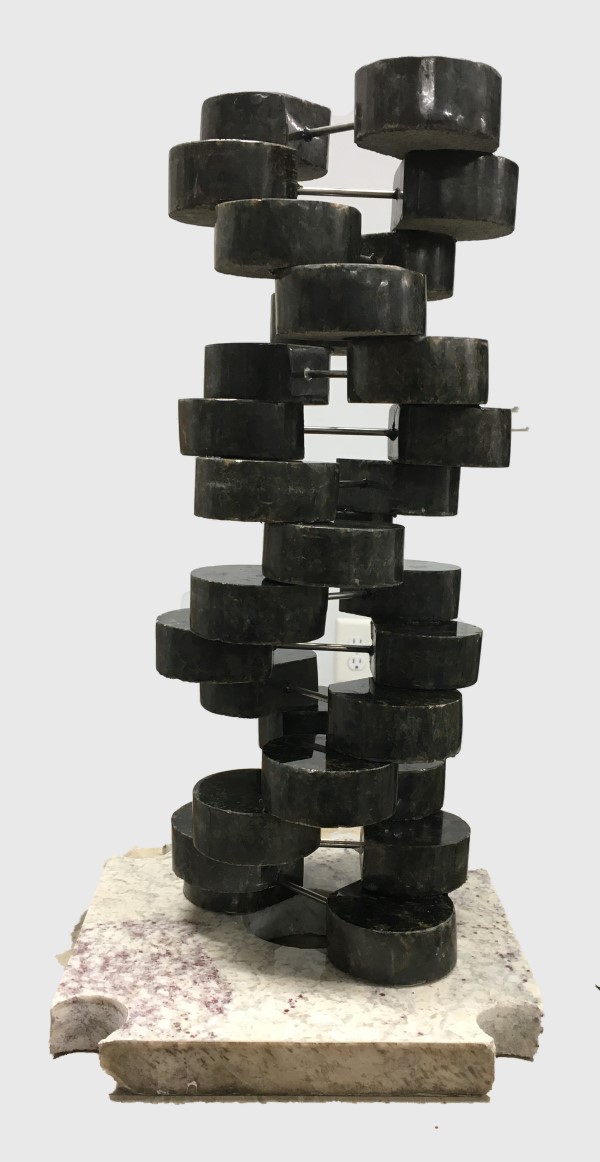
Five minutes after I finished taking photos, the sculpture tumbled to the ground. The polyester adhesive had delaminated under the weight of the helical stack. Some pairs fell far enough to break the epoxy seal holding the steel rod to the disc pair. I rebuild the piece twice more after adding hidden steel pins to hold overlapping discs vertically. Unfortunately, I learned after the second reconstruction that not all discs were of uniform thickness and that the separating rods did little to distribute the load on the layers below. Thus, the final product leans as the helix rises and is missing many of the rods interconnectng the two helices. In spite of my best effort, this piece is nothing more than a pile of rocks.